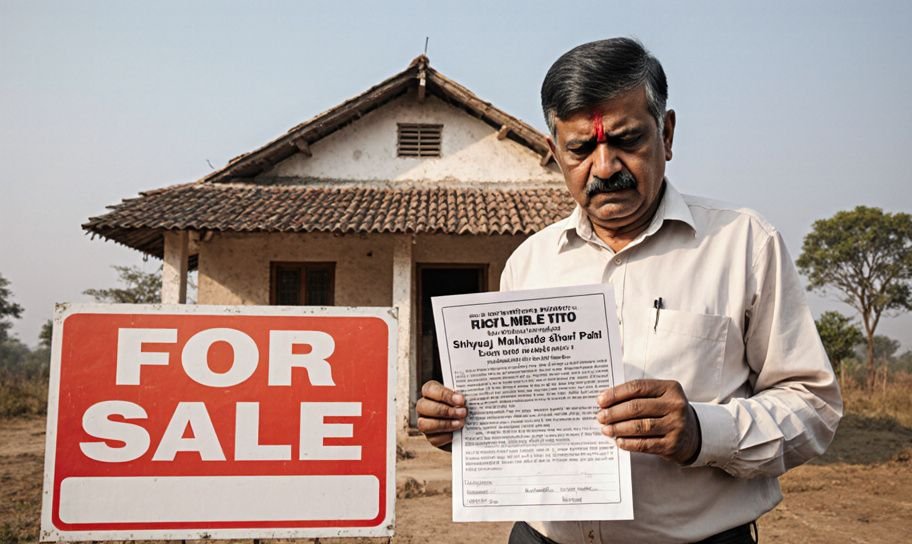
In a recent Supreme Court decision, the court dealt with a complex case involving property auctions, family ties, and legal details. Here's a breakdown of the events and the court's ruling.
Back in 1970, Duli Chand took a loan of ₹20,000 from New Bank of India, using 116 Kanals and 13 Marlas of land as security. Fast forward to 1982, the bank demanded repayment, leading to a court order in 1984 for ₹22,753.
In May 1985, before the bank's request to enforce the court order, Danesh Singh bought part of the mortgaged land. His wife, Pyari, followed in June, buying more land. However, the bank went ahead with the auction in 1988, where Danesh Singh's nephews, who are the ones appealing, bought the entire property for ₹35,000.
Danesh Singh and Pyari claimed they didn't know about the auction until they were stopped from accessing the land in July 1989. They filed a lawsuit asserting their ownership and challenging the auction's fairness.
The Trial Court ruled in favor of Danesh Singh and Pyari, declaring the auction invalid and recognizing their ownership. The Appellate Court and High Court agreed with this decision, noting problems like the auction being held secretly.
The Supreme Court looked closely at the legal aspects, focusing on the rule that stops property transfer during a lawsuit. The court found that Danesh Singh and Pyari got the property while a lawsuit was ongoing, making their claims complicated.
Ultimately, the Supreme Court allowed the appeal, overturning the lower courts' decisions. However, acknowledging the long legal battle and family ties, the court directed the nephews to pay ₹75,00,000 to Danesh Singh's legal representatives within six months.
This case highlights the complex interaction between legal rules and real-world effects, especially in family-related property disputes.