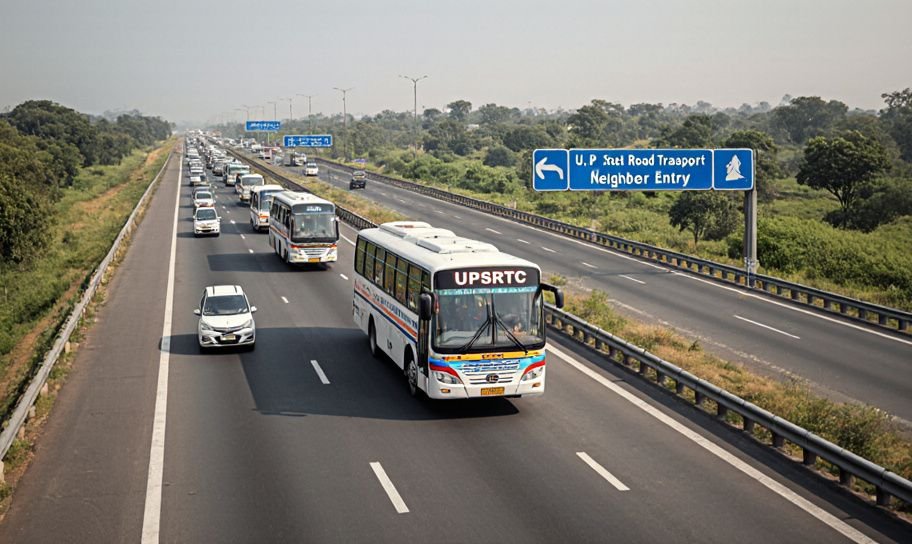
Quick Summary: The Supreme Court dealt with a complicated case involving the U.P. State Road Transport Corporation (UPSRTC) and private bus companies over the right to operate buses on certain routes that go between states. The judgment, delivered by Justice Dipankar Datta, focused on whether private companies could be given permission to run buses on routes that overlap with routes already assigned to UPSRTC within the state.
In this case, the U.P. State Road Transport Corporation, through its Chief General Manager, challenged a decision that allowed private companies to run buses on routes between states. These routes overlapped with routes within the state that were already assigned to UPSRTC.
The issue began with an agreement between Madhya Pradesh and Uttar Pradesh, dated November 21, 2006. This agreement allowed the Madhya Pradesh State Transport Corporation (MPSRTC) to operate on certain routes. However, when MPSRTC stopped its operations, private companies wanted permission to use these routes.
"Clause 4(3) of the IS-RT Agreement provided that once de-notified, the routes in Schedule B would be deemed to be included in Schedule A."
Kashmiri Lal Batra filed a request asking the State Transport Authority of Uttar Pradesh (STA, UP) to approve permits issued by Madhya Pradesh. The High Court told Madhya Pradesh and Uttar Pradesh to make this happen, leading to the UPSRTC's appeal.
Justice Dipankar Datta, along with Justice Augustine George Masih, overturned the High Court's decision. They emphasized that an agreement between states is not a law and cannot override the rules in Chapter VI of the Motor Vehicles Act, which governs State Transport Undertakings.
"An IS-RT Agreement can be executed by two States drawing power from Section 88 of the 1988 MV Act, which is part of Chapter V thereof."
The court stressed the need for discussion between the states to resolve such issues, highlighting the importance of public interest in transportation policies. The judgment also called for a meeting between the transport departments of both states to discuss the future of these routes.
The Supreme Court's ruling confirms that State Transport Undertakings have priority over private companies on routes that are officially assigned to them. It also highlights the need for clear agreements and cooperation between states to ensure efficient public transport services. This case shows the complex balance between laws, state policies, and public interest in transportation.