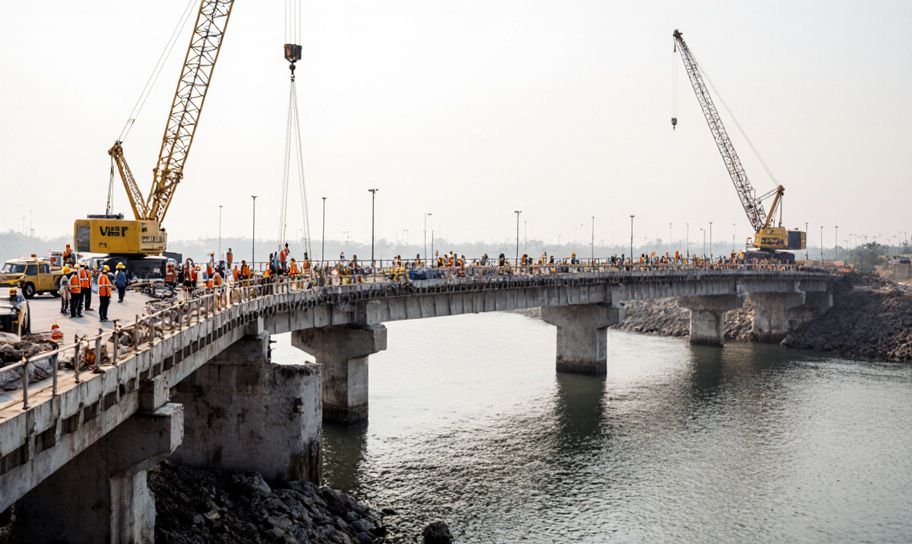
The Bombay High Court recently made a decision in a case involving the State of Maharashtra and M/s Patwardhan Infrastructure Pvt. Ltd. The disagreement was about a construction project for a bridge in Raigad, and the main issue was about payment due to not collecting enough money from tolls.
Back in 1999, the State of Maharashtra gave a contract to Patwardhan Infrastructure to build a two-lane bridge connecting Pen and Alibag across the Dharamtar Creek. This was a toll-based project, meaning Patwardhan could collect tolls from vehicles using the bridge until the project was handed back to the state.
The main problem came up when Patwardhan asked for payment because they didn't collect as much money from tolls as expected. They argued that a meeting held on August 18, 1999, changed the terms of their contract, ensuring payment for any drop in toll collection over 20%.
The key issue in the case was whether the force majeure clause in the contract was changed by the meeting's notes. Patwardhan claimed that any drop in toll collection beyond 20% should be paid for by the state, while the state argued that this wasn't agreed upon.
"The parties merely agreed to delay a decision on such implications to a date when the Rewas-Karanja bridge actually comes about."
Judge Somasekhar Sundaresan decided that the meeting did not change the original contract terms. The court found that the agreement still required a force majeure event to trigger payment, and a drop in toll collection alone wasn’t enough.
The court canceled the earlier decision that favored Patwardhan, saying it went against the basic rules of Indian law. The judge emphasized that the meeting's notes couldn't be treated as changes to the contract.
"The outcome fails the business efficacy test and is contrary to the express terms of the contract."
This case shows how important it is to have clear contract terms and the difficulties of understanding agreements when disagreements occur.